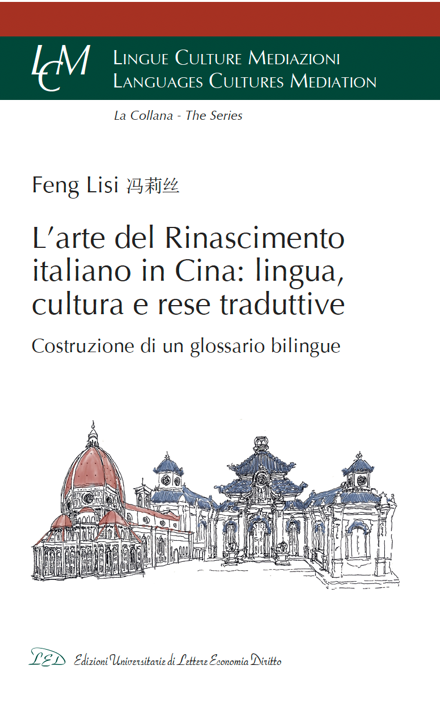
A new book by Dr. Feng Lisi of the Department of Italian at the School of Foreign Studies (SFS) at Nankai University, L’arte del Rinascimento italiano in Cina: lingua, cultura e rese traduttive (Italian Renaissance Art in China: Language, Culture, and Translation), has recently been published by Milan: LED – Edizioni Universitarie di Lettere Economia Diritto. Focusing on the dissemination, translation, and reception of Italian Renaissance art terminology in China, the book reveals the semantic shifts and underlying cultural mechanisms involved in the cross-cultural transmission of related artistic concepts.
With the development of global history and intercultural studies, the Renaissance has gradually transcended its original geographical and historical boundaries, becoming an important perspective from which to examine interactions among different civilizations. Art terminology serves not only as a vehicle for artistic theory and practice but also as a crystallization of cultural memory and intellectual traditions. The book traces the history of cultural exchanges between China and Europe from the late Ming Dynasty to the present day. It pays particular attention to the role of Jesuit missionaries, including Matteo Ricci and Giuseppe Castiglione, in the transmission of art between China and the West, as well as the reception, understanding, and reinterpretation of Italian Renaissance art by Chinese intellectuals in the nineteenth and twentieth centuries. Drawing on the history of Sino-Western cultural exchanges, language contact theory, and translation studies, the research examines the interactions and differences between aesthetic concepts and cultural traditions as reflected in the cross-linguistic transmission of artistic terminology.
The book further draws on three works as its corpus: Cennino Cennini’s Libro dell’arte (The Craftsman’s Handbook), Leon Battista Alberti’s Della Pittura (On Painting), and Giorgio Vasari’s Le Vite (TheLives of the Most Excellent Painters, Sculptors, and Architects). By examining the translation and dissemination of key terms such as prospettiva (perspective), istoria (history painting), and disegno (drawing, design, and conception), the book further analyzes how artistic concepts have evolved and been reconstructed in the process of cross-cultural transmission.
About the Author

Dr. Feng Lisi is a lecturer in the Department of Italian at the SFS at Nankai University. She holds a master’s degree from the University of Padua and a doctoral degree from the University of Milan. She has led one project funded by the National Social Science Fund of China (NSSFC) and has published one monograph, two translated works, and more than 15 academic papers in Chinese, Italian, and English, including papers in A&HCI- and CSSCI-indexed journals.