On the afternoon of June 10, 2026, Professor Yan Chunde, from Beijing Language and Culture University, gave a lecture at the SFS, Nankai University in Tianjin, sharing his decades of scholarship and academic reflections. The event was organized by Nankai University Center for Area Studies. The Dean Professor Yan Guodong, as well as the Director of Nankai University Center for Area Studies, presided over the lecture. More than 30 faculty members and students from 9 language majors attended the event.
Professor Yan Chunde is one of the founding figures of Sinology studies in China. He founded and serves as the editor of Chinese studies, the first specialized Sinology journal in China. He also founded the core journals Chinese Culture Research and Chinese Female Literature Studies. His presided “Series of National Sinology History Books” has published over 60 classic works, becoming important reference literature for Chinese and international Sinology circles.
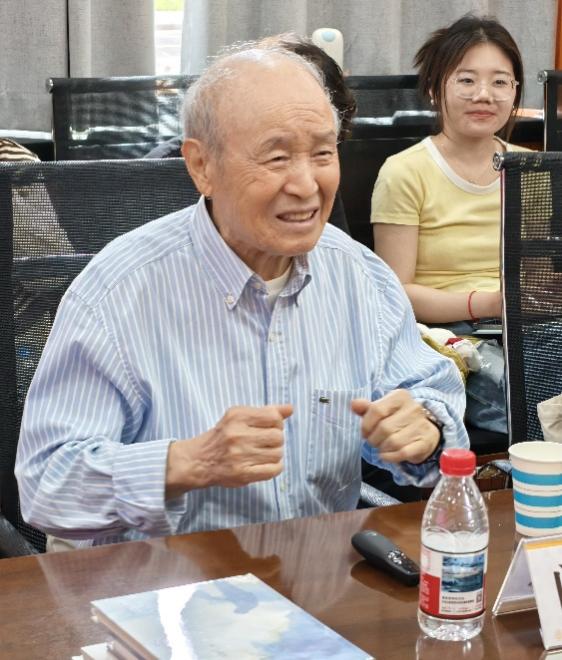
The lecture focused on core topics such as “how to connect with literature,” “how to broaden academic horizons in teaching, research, and journal editing,” and “how to understand the overseas dissemination of Chinese literature and culture”. Professor Yan Chunde first recalled his childhood interest in literature, sparked by reading works such as Pastoral Songs of Tianshan and New Heroes and Heroines. He recounted his arduous studies supported by the state and his university. He emphasized that a true humanistic spirit must be cultivated through classic reading and independent thinking. After graduating from the Chinese Department of Peking University, Yan Chunde went to France to teach for many years. He became the first Chinese scholar to lecture on Lu Xun in France. During his time in Paris, he befriended French Sinologists such as Léon Vandermeersch (Chinese name: 汪德迈) and trained a group of scholars active in China-Europe cultural exchanges. He specifically pointed out that reading and engaging with scholars are directly related to academic growth. While editing the Dictionary of Chinese Writers, he not only studied texts but also interviewed renowned figures such as Ding Ling, Bing Xin, and Ai Qing, combining “textual research” with “field investigation.” He also shared the “data awareness” and “problem awareness” gained from archival work. While in France, he read books by female writers such as Lu Yin and Xie Bingying, who were overlooked by the Modern Chinese Literary History, which motivated him to write Research on 20th-Century Chinese Women Writers. In the 1980s and 1990s, Professor Yan Chunde keenly sensed that domestic research on overseas Sinology was insufficient. He thus opened up a new field in his sixties. Combining his experience of founding journals such as Chinese Studies, he recounted the hardships of self-raising funds and persisting in publication during an era of scarce academic resources. Chinese Studies was indexed in the CSSCI in 2014, following 32 years of relentless effort.
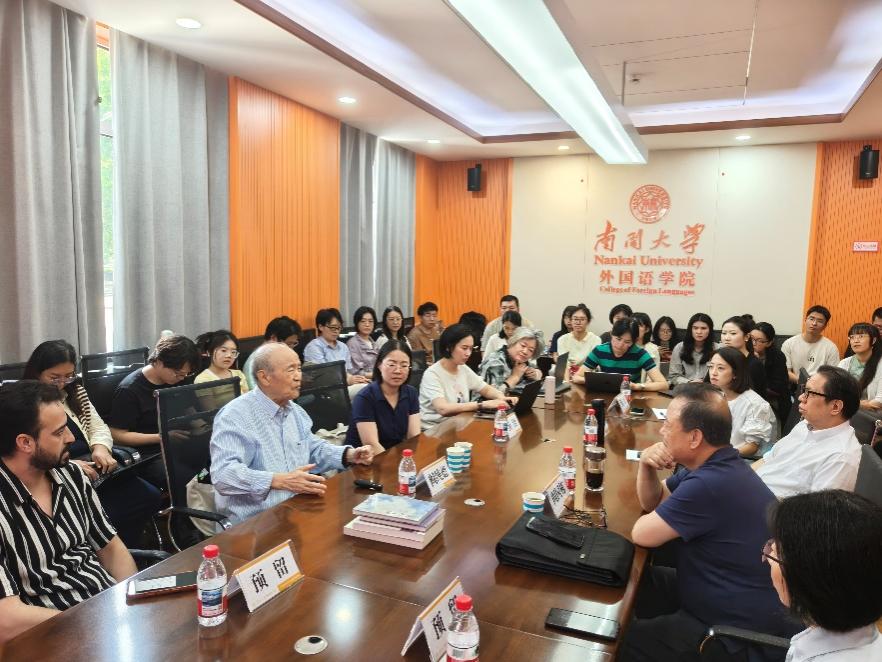
During the Q&A session, Professor Yan Chunde exchanged views with faculty and students on topics such as the overseas dissemination of Chinese literature and culture and how young scholars should respond to the marginalization of the humanities. In response to the limited understanding of China among the general French public, he elaborated on the founding background of Chinese Culture Research. Regarding overseas Sinology methodologies, he encouraged young scholars to dare to question, employ new methods and materials, examine academic history from multiple angles, and avoid simply applying foreign perspectives. He stressed that problem awareness and an open vision are the keys to academic innovation.