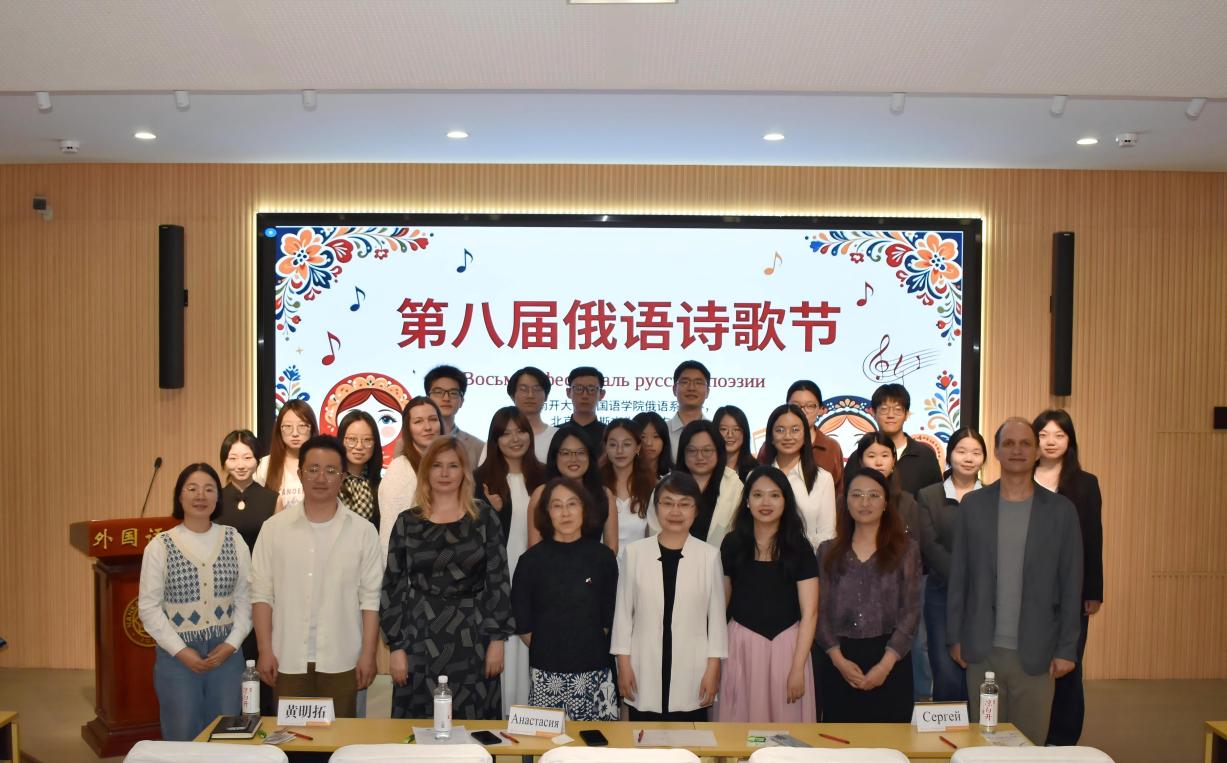
On June 6, marking the 227th anniversary of the birth of renowned Russian poet Alexander Pushkin, the 8th Russian Poetry Festival of Nankai University was held in Lecture Hall 111 of the School of Foreign Studies (SFS) at Nankai University. The event was organized by the Department of Russian and supported by the Russian Cultural Center in Beijing. Faculty members from the Department of Russian attended the event and served as judges for the recitation competition.
Following the traditional formats of individual and group recitation, this year’s Poetry Festival featured three categories based on participants’ academic levels: first-year undergraduates, second-year undergraduates, and graduate students. First, second, third, and special prizes were awarded based on the contestants’ overall performances. The stage came alive with the rhythm and charm of Russian poetry, with each performance showcasing its own distinctive appeal. First-year undergraduates took the stage first. Liu Hanwen delivered a serene and profound rendition of “The Lonely Accordion” (Одинокая гармонь), while Zhang Shuyan gave a poised and elegant performance of “I Have Learned to Live Simply and Wisely” (Я научилась просто, мудро жить). Luo Bei presented “By Lake Baikal” (На берегу Байкала) in a distinctive combination of poetry and song, and Zhao Xinran’s rendition of “To Cain” (Я помню чудное мгновенье) was gentle and lyrical. The second-year undergraduates followed. Yang Wenting once again performed Akhmatova’s poem of the same title, with a more composed tone than before. Dai Rui recited Simonov’s “Wait for Me, and I’ll Return” (Жди меня), delivering the longing and conviction of wartime waiting to everyone in the audience with a powerful and resonant voice. Li Qianming, a first-year research master’s student, gave a rich and solemn rendition of “Mother Russia” (Русь). The research master’s class delivered a group recitation of “There Are No Boring People in the World” (Людей неинтересных в мире нет), characterized by its powerful momentum and well-defined layers. Zou Qing, a first-year professional master’s student, presented a delicate and restrained reinterpretation of Akhmatova’s work. Doctoral students Wang Yue and Nan Jingxian joined Lisa, a Russian international student, in performing an excerpt from Chapter Five of Eugene Onegin (Евгений Онегин). Their coordination was smooth and natural, while their fluent Russian was complemented by Lisa’s authentic native pronunciation.
After intense competition, Zhang Shuyan won the First Prize for her outstanding performance. Luo Bei and Zhao Xinran received Second Prizes, while Liu Hanwen, Yang Wenting, and Dai Rui received Third Prizes. Li Qianming, Zou Qing, Wang Yue, Nan Jingxian, Lisa, and all members of the master’s class received Special Prizes.
At the conclusion of the event, foreign teachers Anastasia Alekseevna Kosmach (Анастасия Алексеевна Космач) and Sergey (Сергей) delivered remarks respectively. They spoke highly of the contestants’ performances, noting that their recitations had gone beyond the level of language learning alone and reached the depths of cultural resonance. Their sincerity and enthusiasm deeply moved everyone present. Professor Wang Lidan then delivered concluding remarks. Looking back on the past eight years, she noted that the Russian Poetry Festival had become a traditional event of the Department of Russian. This year’s festival coincided with the special occasion of Pushkin’s birthday and Russian Language Day, and both the scale of the event and the artistic level of the performances had reached new heights. From undergraduate students majoring in Russian to doctoral students, and from Chinese students to Russian international students, reciters from different academic levels and cultural backgrounds shared the same stage, creating a vivid scene of intercultural dialogue. Professor Wang encouraged the students to take this opportunity not only to hone their skills in language and literature, but also to cultivate greater depth of emotion and thought, expanding the breadth of their lives and elevating their spiritual horizons through immersion in literary classics. Finally, Professor Wang expressed her sincere gratitude to the Russian Cultural Center in Beijing for its long-standing support.
The successful organization of the Russian Poetry Festival has demonstrated its value in helping students engage with literary classics, enhance their humanistic qualities, and promote cultural exchange between China and other countries.