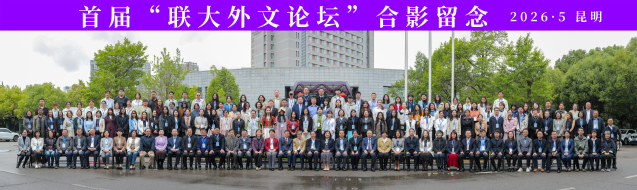
From May 9 to 10, the First National Southwestern Associated University Foreign Languages Forum was successfully held at Yunnan Normal University. The forum was hosted by the School of Foreign Languages and Literature of Yunnan Normal University and co-organized by the School of Foreign Languages of Peking University, the Department of Foreign Languages and Literatures of Tsinghua University, and the School of Foreign Studies (SFS) at Nankai University. More than 120 representatives from universities and research institutions across China gathered at Yunnan Normal University to revisit the educational and scholarly traditions of the National Southwestern Associated University and discuss the future development of foreign language education and research in China in the new era.
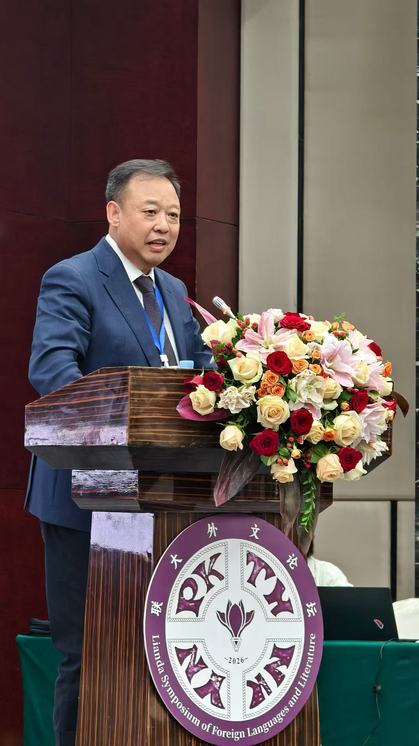
Prof. Yan Guodong, Dean of the SFS, delivered a keynote speech entitled “Nankai Foreign Language Scholars at the National Southwestern Associated University”. In his presentation, he noted that a number of Nankai scholars from the Department of Foreign Languages and Literatures of the National Southwestern Associated University—including Liu Wuji, Mu Dan (Zha Liangzheng), Bian Zhilin, Luo Ailan, Fu Enling, Jin Di, and Yang Yi—made significant contributions to carrying forward the patriotic spirit of Nankai's foreign language disciplines and to shaping their academic strengths. The intellectual and spiritual legacy they left behind constitutes an invaluable academic heritage. Centered on Dedication to Public Interests, Acquisition of All-round Capability, it exemplified how intellectuals integrated their professional expertise into the national cause during times of crisis. Driven by the motto “Aspiration for Progress with Each Passing Day”, it established a comparative vision that transcended disciplinary boundaries and bridged Chinese and Western cultures. Combining the creativity of poets with the meticulousness of craftsmen, these scholars forged an aesthetic standard for literary translation in pursuit of artistic excellence. Through perseverance and unwavering determination, they broke new academic ground and achieved theoretical innovation. Together, these qualities have shaped the most treasured academic tradition and intellectual character of Nankai’s foreign language disciplines.
The forum featured 18 parallel sessions covering six major areas within the discipline of foreign languages and literatures, including foreign literature, foreign linguistics and applied linguistics, comparative literature and intercultural studies, translation studies, area studies, and foreign language education. Participants engaged in in-depth discussions on the future development of foreign language disciplines in China. Faculty representatives from the SFS participated in the parallel sessions, presenting their latest research findings and exchanging views with scholars from across the country on new directions and approaches for disciplinary development. Among the presentations, Prof. Wang Lidan explored historical writing and value reconstruction in the documentary plays of Mikhail Shatrov; Prof. Zhang Zhizhong reexamined Xu Yuanchong’s “Three Beauties” Theory in the English translation of classical Chinese poetry; Prof. Lu Ying introduced France’s legislative proposal on the restitution of cultural relics from the Old Summer Palace; Prof. Yang Lin reviewed the beginnings of inter-party diplomacy between China and Italy; Associate Prof. Zhang Qiang reassessed the significance and influence of Liu Wuji’s translation and introduction of Confucius; and Dr. Guo Laimei discussed the translation and interpretation of The Great Tang Records on the Western Regions in Russia.