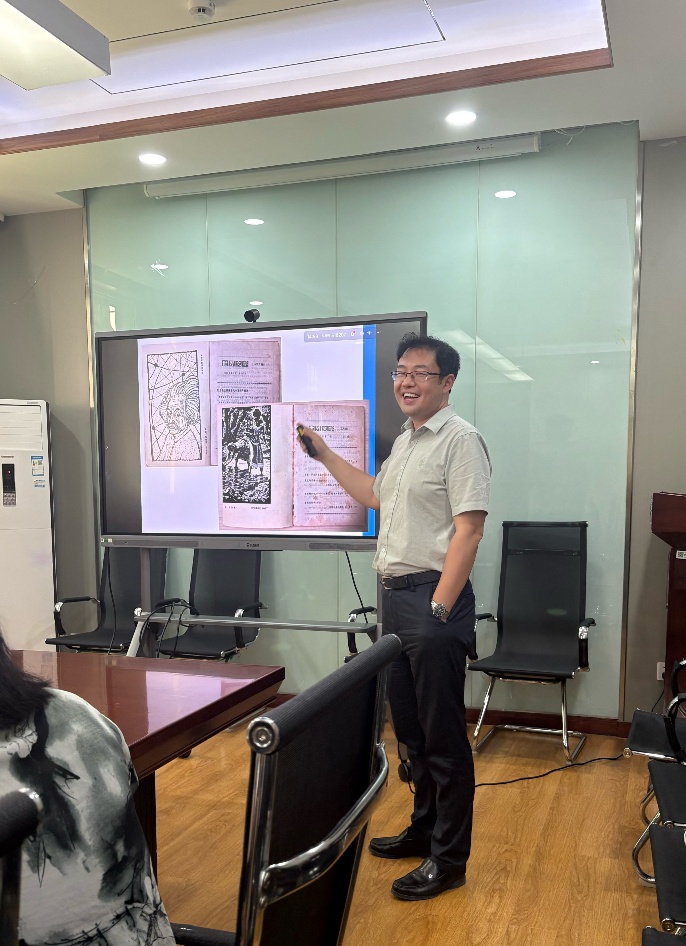
On the afternoon of June 10, Prof. Cui Feng, doctoral supervisor at the School of Humanities, Nanyang Technological University (Singapore), was invited to deliver an academic lecture for faculty and students of the School of Foreign Studies (SFS) at Nankai University. The lecture, titled “Problem Consciousness and Methodology in the Study of Contemporary Chinese Translation History: A Case Study of Literary Translation Journals,” was organized by the Center for International Communication of Chinese Culture at the SFS. It drew faculty and students from the departments of English, French, Japanese, German, and Portuguese Languages. The session was chaired by Prof. Hu Cui’e, Director of the Center.
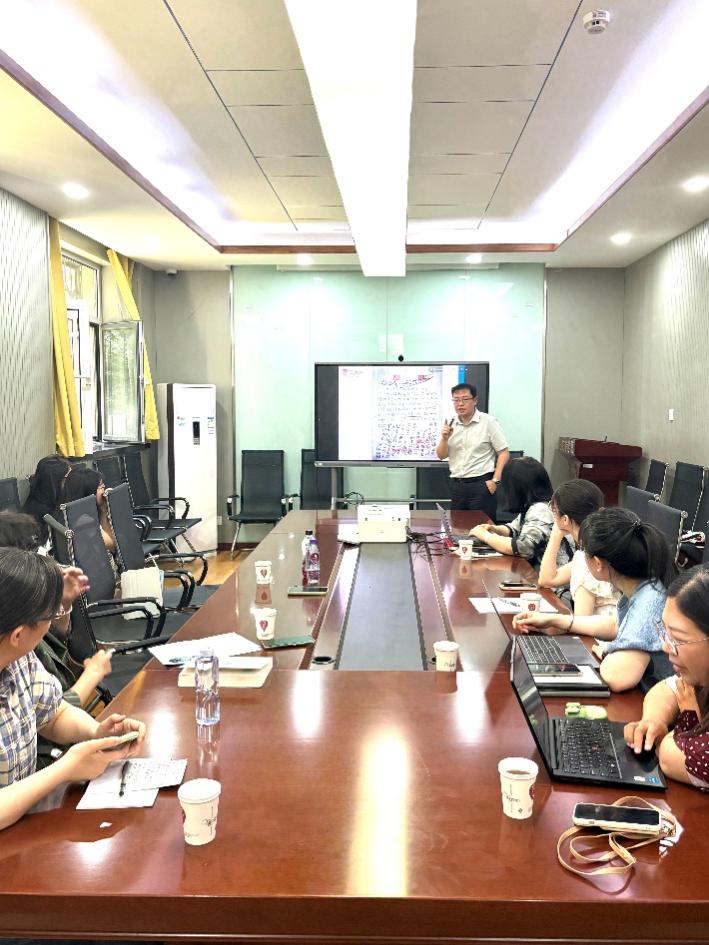
Prof. Cui began by briefly introducing his monograph Translation, Literature and Politics: A Study of World Literature (1953–1966), before transitioning to the central theme of the lecture — how translated literature, within the socio-political context of target-language China during specific historical periods, engaged with mainstream political and cultural discourse through the medium of literary journals. He outlined the development of World Literature magazine in three phases, taking as the main thread the shifting positioning of the nation-state by translators and foreign literature scholars. Through detailed textual analysis of archival materials, he offered a clear and compelling reconstruction of the trajectory of foreign literature translation and introduction in China during the 1950s and 1960s. His lecture was intellectually engaging and richly referenced, offering accessible yet incisive perspectives on the theories, principles, and methodologies of translation history and literary translation journal studies.
In the concluding session, Prof. Cui shared practical insights on academic publishing in international journals, topic selection, and strategies for balancing personal research interests with national policy orientation. Faculty and students engaged actively in discussion and expressed that they had greatly benefited from the lecture, commending Prof. Cui’s scholarly rigor and deep expertise in the field of translation history.
Prof. Cui currently serves as Coordinator of the Translation Minor Program and a member of the Department Committee at Nanyang Technological University. He is also a visiting professor, distinguished researcher, or executive council member at institutions including Beijing Jiaotong University, Shanghai International Studies University, Nanjing University of Information Science and Technology, and the World Interpreter and Translator Training Association. In addition, he is an editorial board member of Humanities and Social Sciences Communications (SSCI, A&HCI Q1), guest editor for the Interpreter and Translator Trainer special issue “Transforming Translation Education Through Artificial Intelligence” (2025), and reviewer for multiple SSCI, A&HCI, and CSSCI journals. He has published over fifty academic papers, along with eight monographs, edited volumes, and translations in Chinese and English.