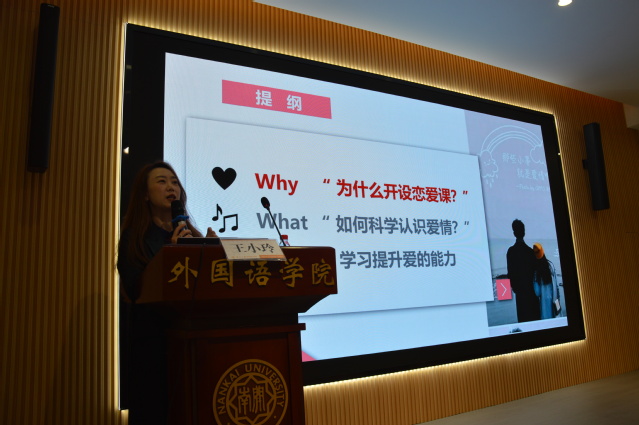
On the morning of April 17th, Ms. Wang Xiaoling, deputy director of Tianjin University Mental Health Education Center, was invited to deliver a special lecture on "Revealing Love Psychology and Improving Love Ability" at the "Walk with You" secondary psychological counseling station of the School of Foreign Studies (SFS), which attracted more than 150 teachers and students. The lecture focused on the popular topic of college students' love psychology, combining scientific theories with practical techniques to help young students navigate emotional dilemmas and enhance their ability to nurture intimate relationships.
In the lecture, Ms. Wang Xiaoling provided a detailed analysis of common dating challenges faced by college students, using counseling case studies. She highlighted frequent issues among students: uncertainty about how to confess feelings, insecurity in relationships, fear of forming intimate bonds, helplessness when conflicts occur, and difficulty moving past heartbreak. “Many students blame themselves for relationship setbacks, but these very challenges are growth opportunities,” she emphasized the importance of addressing problems directly and learning scientific coping strategies.
Subsequently, focusing on “how to prepare for love,” Ms. Wang Xiaoling proposed a “three-dimensional growth plan.” On the psychological level, one must embrace their authentic self, firmly believe “I am worthy of love,” approach relationships with a calm mindset, and avoid excessive anxiety. On the physical level, regular exercise and attention to personal appearance enhance outward confidence, injecting vitality into social interactions. On the behavioral level, actively create social opportunities while cultivating psychological resilience to withstand emotional setbacks.
"Love is an ability that needs to be learned and practiced." She suggested that students jump out of the "passive waiting" and actively create conditions for their own happiness.
In the interactive session, Ms. Wang used role-playing scenarios to reveal the core skill in romantic relationships—empathy. “Expressing love isn't about self-indulgence; it's about conveying your feelings in ways that resonate with your partner,” she explained. She summarized five “love codes”: carefully prepared gifts, sincere affirmative words, high-quality companionship, moderate physical contact and meticulous care actions. She also reminded students to adapt these approaches flexibly based on individual preferences. Regarding relationship maintenance, she introduced the concept of “emotional bank account”: both partners must continuously “deposit” affection through daily care, respecting boundaries, setting reasonable expectations, and mutual praise to prevent conflicts from depleting the relationship.
SFS attaches great importance to students' mental health education. The secondary psychological counseling station of "Walk with You" of the Institute continues to innovate and carry out mental health education according to the characteristics of students. Through specialized lectures, group counseling, and the development of a mental health committee team, it guides college students to enhance self-awareness, build psychological resilience, and supports their all-round development.