On the afternoon of March 27, Prof. Tao Feng from the College of Philosophy at Nankai University delivered an academic lecture titled “AI for Humanities: Challenges and Opportunities for Liberal Arts in the AI Era” at the School of Foreign Studies (SFS). The event was chaired by Xiang Yu, Deputy Secretary of the SFS CPC Committee and Vice Dean of SFS, and attended by faculty and students from the Department of English, Translation,Japanese, Russian, French, German, Spanish, Italian, Portuguese, Arabic, and Foreign Languages for Non-Majors.
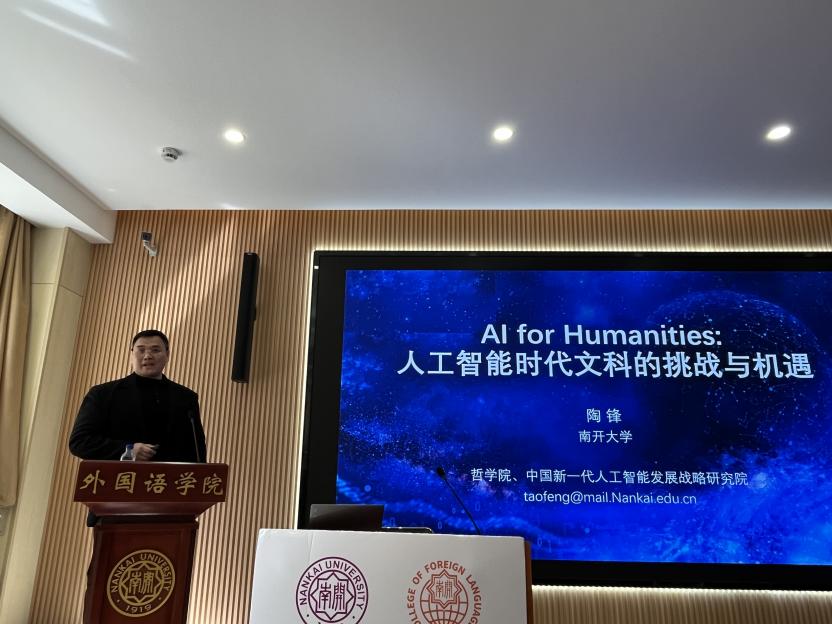
Prof. Tao, who holds a Ph.D. in Philosophy from Tsinghua University, is a Professor and Doctoral Supervisor at the College of Philosophy of Nankai University and a researcher at the Chinese Institute of New Generation Artificial Intelligence Development Strategies (CINGAI). He previously studied at the University of Bonn as a visiting scholar sponsored by the China Scholarship Council and has conducted academic exchanges at the University of Hawaii at Manoa, Boston University, and Humboldt University of Berlin. His research spans AI ethics, aesthetics, and the philosophy of action, reflecting strong interdisciplinary expertise.
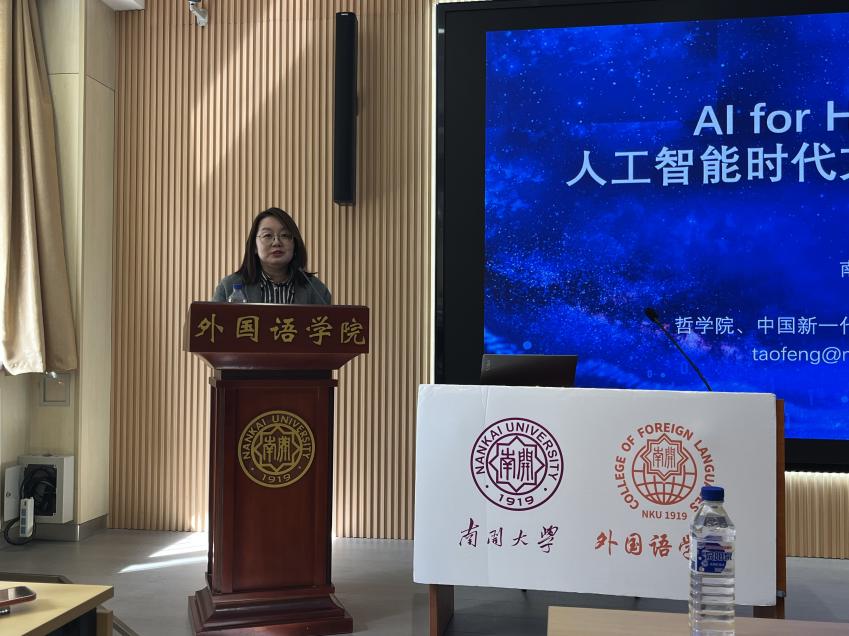
Prof. Tao began the lecture by exploring AI art as a starting point, elaborating on the philosophical significance of interactivity as AI’s technical essence. He emphasized that the interactive nature of AI in the humanities not only involves technical information exchange but also embodies ethical dimensions of social interaction, resonating with the traditional Chinese philosophical concept of “interactions between heaven and mankind.” On addressing AI’s ethical challenges, such as value alignment, he proposed building moral datasets through technical alignment (forward alignment) and governance alignment (backward alignment), enabling scenario simulation and value assessment.
When discussing AI’s “knowledge crisis,” Prof. Tao analyzed the causes and philosophical implications of AI hallucinations. He noted that while technical measures like parameter optimization and data screening can mitigate surface issues, a fundamental solution requires nurturing the humanistic spirit—cultivating critical thinking through humanities education and deepening understanding of knowledge itself to help individuals see beyond technological myths. This perspective resonated strongly with the audience.
In the climax of the lecture, Prof. Tao returned to philosophical ontology, addressing AI in the humanities through the lens of the philosophy of action, centered on the ultimate question of “the meaning of human existence.” He shared his views on humanities education in the AI age combined with the background of the development of literal arts in the AI+ new age , covering digital humanities, new interdisciplinary research in the humanities, and New Liberal Arts education.
During the Q&A session, youth faculty and graduate students actively engaged with Prof. Tao on issues such as the development of foreign language education in the AI era and the cultivation of critical thinking. Youth teachers from various departments exchanged views with him on the significance and value of the New Liberal Arts in an era of both AI risks and opportunities. Drawing on their specific disciplines and teaching experience, they explored potential negative impacts of neglecting the humanities, including the instrumentalization of reason, the rise of “technological nomads,” and data violence. The lively discussion lasted nearly an hour.
The lecture addressed cutting-edge issues in artificial intelligence and New Liberal Arts development. Participants agreed that Prof. Tao’s presentation offered penetrating philosophical insight into frontier technologies while embodying the practical relevance of humanistic concern, providing important inspiration for disciplinary transformation in the age of intelligence.